Josef Ridny
Felix AustriaJosef Ridny is first known to Stefania as a medical student in Doctor Anger’s circle and later reappears in the Anger household as Father Josef. His place in the story is defined by that transformation: once an object of private longing, he becomes a priest whose gentle manner and uncompromising regard for religious practice expose the distance between Stefania’s need for consolation and what he can provide.
Identity and Introduction
Before becoming a priest, Josef is one of the young medical students Doctor Anger brings home to discuss scientific work and hear readings on medicine. Stefania initially registers him as one among a group of hungry, shabby students; her first distinct awareness of him comes when Adèle teases her for failing to notice that the tall, gaunt student is watching her. Josef is later identified as Josef Ridny, a former student of Doctor Anger.
When he returns to the household as Father Josef, Stefania recognizes the young man she knew beneath the clerical identity. His appearance remains memorable to her: dark, tightly curled hair, a pale face marked by smallpox, and a thin, elongated frame. Yet the force of the encounter lies less in recognition than in his manner toward her. Stefania experiences his gaze as tender and accepting, without sexual insinuation, and finds herself unable to hide from it.
Medical Inquiry and Religious Interest
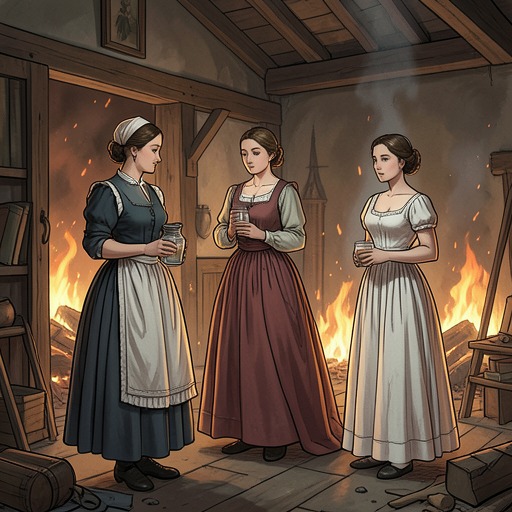
Josef’s student discussions take place in a household shaped by Doctor Anger’s teaching. The doctor reads aloud from works on hygiene, surgery, wounds, and the nervous system, while the students listen respectfully. Stefania serves them hot drinks and, at times, food including goat cheese, sardines, herring, or grilled blood. Her distaste for the students’ unwashed collars and loud, eager conversation contrasts with their intellectual seriousness and gives the gatherings a material, domestic setting.
Josef’s particular interests connect medical experimentation with questions of belief. He is animated by hypnosis and by James Braid’s proposed use of hypnotic anesthesia; he also considers cocaine a powerful anesthetic and attributes to it a broad range of therapeutic benefits. At the same time, he is intrigued by Charcot’s comparison between hypnosis and religious faith. He reasons that cures attributed to saints may operate through a mechanism comparable to hypnotic treatment, treating miraculous healing as a subject for investigation rather than dismissing it outright.
That inquiry draws him repeatedly to the miraculous Virgin of Tenderness icon in the Armenian cathedral in Stanislaviv. He walks its cold floor and studies the record of people who received grace or witnessed miracles, including accounts of relief from illness and of the icon appearing amid blue clouds during a funeral service. His interest holds scientific explanation and devotional testimony in the same field of attention.
Stefania and the Household
Stefania’s attachment begins before she admits it to herself. When Josef visits, she feels transported and notices her heart beating faster; she is secretly proud when Doctor Anger praises Josef’s words, but conceals that pride even from herself. The feeling is represented as a fragile, painful pressure rather than an acknowledged romance. Her later recollection of these visits is colored by guilt and unease, as though remembering them reopens old wounds.
On a later visit, Josef tells Adèle and Petro that he expected to see Madame Adèle but had not expected Stefania to still be in the house. He had thought she would have married and left; instead, he remarks on her and Adèle’s continued inseparability and says Doctor Anger would have been pleased by her fidelity. Petro turns the remark into a joke about Stefania’s reluctance to make a man happy, presenting her continued presence as a treasured, almost imprisoned possession. The exchange makes visible the household bond Josef has encountered: Stefania has remained attached to Adèle rather than building the independent life he had assumed for her.
The remembered courtship episode ends in alarm rather than fulfillment. After Josef has disappeared for a time, Adèle rushes to Stefania while she is putting Doctor Anger’s collars and cuffs into a dresser. She reports that Mr. Ridny has arrived in formal dress with a bouquet of white chrysanthemums and announces that he intends to propose. Stefania turns pale, her mouth dries, and she searches the room for a way out. Adèle offers to say that she is absent, showing that she recognizes Stefania’s distress and can intervene on her behalf. The episode is preserved as a thwarted proposal, not as a marriage or a completed departure from the household.
Priesthood, Limits, and Narrative Significance
As Father Josef, he offers Stefania a strikingly compassionate presence. His words and attention seem to accept her without demanding that she become more respectable or more desirable. But his priestly role also imposes a firm boundary when she seeks confession: he tells her that he cannot hear it outside a church, while she cannot enter the church because it is inside a prison. Stefania argues that a sinner, a priest, and God are already present, yet Josef does not set aside the rule. The encounter ends in her collapse into tears, making the institutional limit inseparable from her desperate need for spiritual relief.
In a later conversation, Josef speaks at length about the commandments, the Law of Moses, service with all one’s heart and soul, suffering, submission, and love of God. He presents divine love as something that exceeds the identity or method of the person serving, and describes human beings as having the possibility of becoming like God. His teaching reframes service as spiritual devotion, but it also reaches Stefania through the existing conditions of her life in the Anger household, where service and attachment are difficult to disentangle.
Josef’s character therefore occupies a meeting point between empirical inquiry and religious authority, and between personal tenderness and the limits of his office. Stefania’s memory gives his appearance and gestures an emotional intensity he does not explicitly reciprocate; his later vocation offers her consolation, but not the unrestricted absolution she seeks. Through him, the novel makes faith neither a simple alternative to science nor an easy answer to emotional dependence: it is at once a field of investigation, a practice governed by rules, and a language in which service can acquire sacred meaning.